WHO I AM
Hi, I’m Rob.
12 years in venture capital, strategy consulting, and startup operations. My job is investing in AI companies. My passion is building agents that create value for myself, my clients, and my employer.

The world has changed:
AI changed the rules of the game. The new world demands a step change in agent development and orchestration skill. That only comes from rolling up your sleeves and building. This site shares what I've built, and what I'm thinking and writing about.
Things I'm Building
Three agents, three different architectures and levels of complexity
Production-grade diligence automation — an 8-pillar Digital Maturity Assessment
Digital Maturity Assessment Synthesis Agent (PE / M&A)
Problem
Diligence teams conducting a digital maturity assessment on a target company can spend weeks on synthesis: reading stakeholder interviews, mapping evidence to a rubric, scoring and sizing opportunities, preparing an executive report. The DMA synthesis agent accelerates and standardizes this process, evaluating targets across 8 pillars (e.g. Data Foundation, Tech Architecture, Process Automation).
Approach
An 8-node LangGraph pipeline takes an engagement package (i.e. structured C-suite interview notes, data profiling tables, app integration inventory) and produces a complete readout: an evidence-grounded score across all 8 pillars, targeted follow-up questions for any pillar where the evidence is too thin, and a sized, thesis-weighted list of the top value-creation opportunities.
Result
Produces 8 output files per run - full report, executive summary, scored heatmap, risk register, initiative backlog, pillar narratives, and process brief - in under 15 minutes.
Architecture
LangGraph, 8 nodes: Intake → Evidence Synthesiser → Pillar Scorer → Follow-up Generator -> Follow-up Integrator → Benefits Sizer → Output Generator → Report Assembler
Self-directed follow-up loop generates role-specific follow-up questions to address evidence gaps
LangSmith/Langfuse tracing on every run
Full eval suite confirms scorer consistency and rubric alignment against known-answer bundles
Video Walkthrough

Architecture diagram

Multi-agent ‘research-to-publish’ system for thought leadership content
LinkedIn PoV Agent
Problem
Producing a well-researched LinkedIn article historically meant stitching together deep research, multiple cycles of critique and iteration, adjustments for tone matching the article intent / target audience - a manual workflow reliant on multiple tools and hours.
Approach
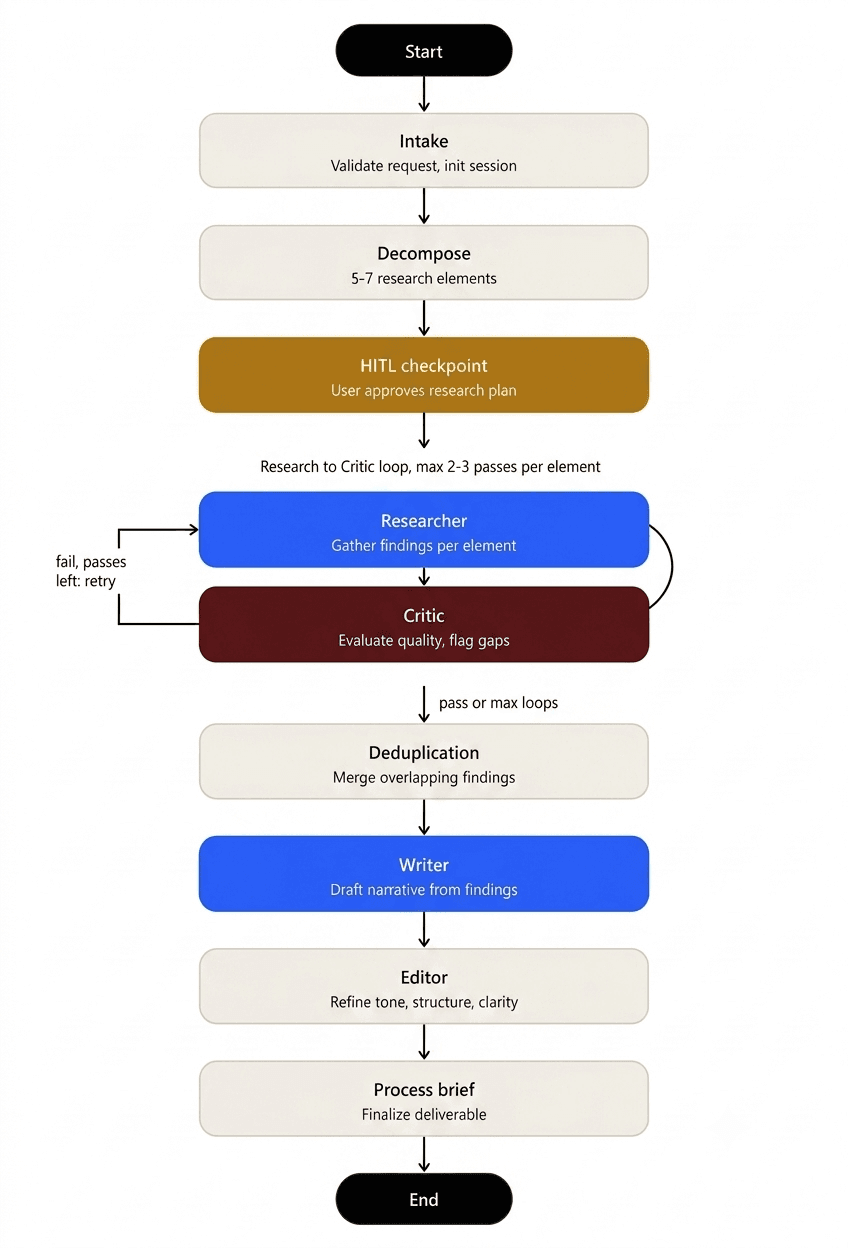
Six coordinating agents on a shared LangGraph state: an Orchestrator decomposes the topic into research elements, a Researcher and Critic run an iterative loop per element (the Critic scores depth, accuracy, and actionability, and routes weak research back for another pass), a human-in-the-loop checkpoint lets the user review research intent before it begins; a Writer and Editor integrate the diverse research components into a final piece.
Result
A streamlined article production agent. 8-12 minutes per run, producing seven output files including the final article, all research documents, and a process brief documenting every decision the pipeline made. Can either be published as is, or used as a '90% done' base, that users can tweak in their preferred LLM before publication.
Architecture
LangGraph StateGraph with a cyclic conditional edge (Researcher ⇄ Critic) - live web research per element, not vector/RAG retrieval
Human-in-the-loop interrupt - user reviews and edits research intent before the loop starts
Six agents, one shared PipelineState - each with clearly scoped read/write responsibility
Structured JSON at every hand-off; graceful degradation on rate limits
Video Walkthrough

Architecture diagram
Investment-grade research - theme in, ranked shortlist out
Thematic Stock Screener
Problem
Screening public markets for stocks that fit a specific thematic lane (e.g. "Physical AI / robotics") means manually pulling a candidate list and financials, iterating on your analysis and building a prioritized view - a few hours of grunt work before the actual decision-making can start.
Approach
A five-step pipeline: the user gives a theme and optional filters (market cap, region); the agent researches the space via live web search, pulls up-to-date financial data per candidate, scores and ranks every company, and writes a structured research report.
Result
Produces a ranked JSON shortlist with per-dimension scores plus a human-readable markdown report, in minutes. Tested end-to-end on multiple themes (e.g. Physical AI/robotics, Sovereign AI Infrastructure).
Architecture
Python + Anthropic SDK (tool use / function calling) + yfinance + Pydantic.
A five-step linear pipeline with three distinct tool calls: web research, financial data fetch, scoring
Every tool output schema-validated - no free-text parsing
Full cost + latency logging across the pipeline
Video Walkthrough

Architecture diagram

Things I WRITE ABOUT
Published thought leadership
driving engagement & network growth
The Four Tiers of AI Competency & Where You Actually Sit
Impressions: 1.5K
Engagements: 25
Followers gained: 1
“The World Cup Is Rigged” some say. The Real Answer Is More Uncomfortable.
Impressions: 108K
Engagements: 130
Followers gained: 21
AI: The SaaS Killer or Tech Debt Sleeper Agent?
Impressions: 5K
Engagements: 44
Followers gained: 5
Being Right about Trillion Dollar Valuations Doesn't Matter If The Leverage Calls First
Impressions: 21K
Engagements: 52
Followers gained: 22
Are You Building a Life for a World That No Longer Exists?
Impressions: 2K
Engagement: 25
Followers gained: 2
AI Model Wars Are a Distraction. The Future is Training Environments.
Impressions: 1K
Engagement: 21
Followers gained: 1